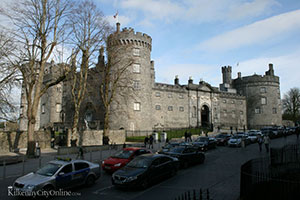
Kilkenny Castle was founded in Medieval times, but its most significant moments have been played out during more recent history. The castle was featured in Oliver Cromwell's re-conquest of Ireland in 1650; and was besieged during the Irish Civil War in 1922.The architect who built the White House in Washington, D.C., James Hoban, was raised on the Earl of Desart’s estate in Cuffesgrange, near Callan in Co. Kilkenny.
Kilkenny is 117 kilometres (73 mi) away the capital Dublin and 48 kilometres (30 mi) north from the nearest city Waterford. Wexford is 80 kilometres (50 mi) to the south-east and Limerick is 122 kilometres (76 mi) to the west.
"To understand Kilkenny's unique character one should retire from the busy streets to the lovely Castle Park and, standing within the shadow of the ancient pile, contemplate the great jumble of roof-tops, old and young, which tumble down to the quiet-flowing river beneath. Here dove-grey spires and battlemented towers proclaim a city old in Christian living and wise in human experience. One can feel the heartbeat of an ancient civilised community."
Katherine M Lanigan, Gerald Tyler, 'Kilkenny, Its Architecture & History', Appletree Press 1977
St Canice's Cathedral, also known as Kilkenny Cathedral, present building dates from the 13th century and is the second longest cathedral in Ireland. The Cathedral is named after Saint Canice, who also gave his name to the city.
Irish legend describes Dunmore Cave, seven miles north of Kilkenny, as one of Ireland’s darkest places and the site where the monster Luchtigen 'The Lord of the Mice' was killed.
Kilkenny Castle has soared past some incredible competition to take the title of the most popular paid visitor attraction managed by the Office of Public Works (OPW) in Ireland.
AKA is a voluntary run arts festival that showcases the hard work and talent of independent artists and community groups across Kilkenny county and city.