Collectively, Kilkenny people are known as 'The Cats', most specifically in the arena of hurling
The gravestone of Daniel O’Connell in Glasnevin Cemetery, Dublin is made from Kilkenny black marble, and the stone was also used in the construction of Cobh Cathedral in Cork
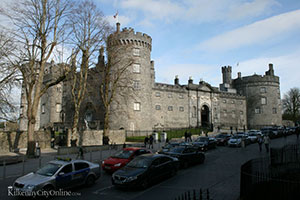
Nowadays, Kilkenny Castle is effectively three-sided. One of the four walls - and one of the great round drum towers - has disappeared over time.
Where did it go? Well, the Eastern wall and the North-Eastern tower were blown up during the 1650 Cromwellian siege of Ireland.
"To understand Kilkenny's unique character one should retire from the busy streets to the lovely Castle Park and, standing within the shadow of the ancient pile, contemplate the great jumble of roof-tops, old and young, which tumble down to the quiet-flowing river beneath. Here dove-grey spires and battlemented towers proclaim a city old in Christian living and wise in human experience. One can feel the heartbeat of an ancient civilised community."
Katherine M Lanigan, Gerald Tyler, 'Kilkenny, Its Architecture & History', Appletree Press 1977
Kilkenny is 117 kilometres (73 mi) away the capital Dublin and 48 kilometres (30 mi) north from the nearest city Waterford. Wexford is 80 kilometres (50 mi) to the south-east and Limerick is 122 kilometres (76 mi) to the west.
The elevation of Kilkenny is 60 metres (200 ft) above sea level. The area of Kilkenny borough is 3.74 square kilometres (1.44 sq mi). Kilkenny is the smallest city in Ireland and although all cities in Ireland are by the coast or along a river Kilkenny is the only city that is not tidal.
Kilkenny Castle has soared past some incredible competition to take the title of the most popular paid visitor attraction managed by the Office of Public Works (OPW) in Ireland.
AKA is a voluntary run arts festival that showcases the hard work and talent of independent artists and community groups across Kilkenny county and city.