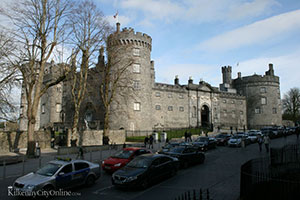

Nowadays, Kilkenny Castle is effectively three-sided. One of the four walls - and one of the great round drum towers - has disappeared over time.
Where did it go? Well, the Eastern wall and the North-Eastern tower were blown up during the 1650 Cromwellian siege of Ireland.
Kilkenny's most one sided All-Ireland finals win was in 2008 when they beat Waterford by 23 points with a scoreline of Kilkenny 3-30 to 1-13 Waterford
"To understand Kilkenny's unique character one should retire from the busy streets to the lovely Castle Park and, standing within the shadow of the ancient pile, contemplate the great jumble of roof-tops, old and young, which tumble down to the quiet-flowing river beneath. Here dove-grey spires and battlemented towers proclaim a city old in Christian living and wise in human experience. One can feel the heartbeat of an ancient civilised community."
Katherine M Lanigan, Gerald Tyler, 'Kilkenny, Its Architecture & History', Appletree Press 1977
In 1650 invading Cromwellian forces mounted an attack on Kilkenny castle and although it was initially successfully defended they eventually managed to take control of the city by another route.
The annals tell of a terrible massacre which took place in Dunmore Caves, with 1000 people killed by attacking Vikings in 928AD. Over the years there have been numerous finds of human bones, which together with finding of the Viking artifacts, seem to bear out that terrible tale.
Kilkenny Castle was founded in Medieval times, but its most significant moments have been played out during more recent history. The castle was featured in Oliver Cromwell's re-conquest of Ireland in 1650; and was besieged during the Irish Civil War in 1922.
Kilkenny Castle has soared past some incredible competition to take the title of the most popular paid visitor attraction managed by the Office of Public Works (OPW) in Ireland.
AKA is a voluntary run arts festival that showcases the hard work and talent of independent artists and community groups across Kilkenny county and city.