






KILKENNY CASTLE - View
Map (Ref: No.1)
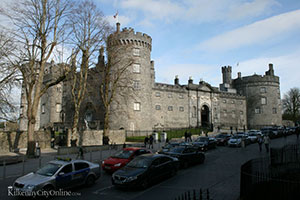
This
superb castle is located on elevated ground beside
the river at the south-eastern end of the city.
The castle was built in the thirteenth century on
the site of an earlier fort. However, the present
building is vastly different from the stronghold
erected by Strongbow in the middle ages. Despite
this, the present structure retains the architectural
lines of a medieval castle. The building forms three
sides of a quadrangle, with three of the four original
round towers intact. The Butlers, the Earls of Ormonde
(an Hibernicised Norman clan), occupied the castle
from the fourteenth century onwards. In modern times,
the castle has been restored to its former glory
by the state, and was officially open to the public
in 1976. There is an exhibition hall open to the
public in the Old Castle Stables.
Kilkenny Castle provides guided tours, an art
gallery, a café during summer, extensive
grounds and a childrens play area.
Times: Open Oct to March, daily 10.30am
- 12.45pm & 2pm - 5pm (Mon - Sat), 2pm - 5pm
(Sun).
Tel: (056) 7721450.
|
| |
| |
BUTLERS GALLERY - View
Map (Ref: No.1)
Butlers gallery showcases contemporary art culled
from both its permanent collection and from external
travelling exhibitions. The gallery is located within
Kilkenny Castle.
Opening hours daily - 10.30am to 5pm. Closed
12.45pm to 2.pm.
Tel: 056 7761106. Fax: 056 70031. Email: butgal@indigo.ie.
|
| |
| |
NATIONAL CRAFTS GALLERY View
Map (Ref: No.2)
The
National Crafts Gallery is located in Castle Yard
directly across from Kilkenny Castle. This gallery
was initiated by the Crafts Council of Ireland with
the objective of stimulating an innovative and quality
design ethos in the Irish crafts sector. The gallery
boasts an impressive range of craft exhibitions
that successfully communicate and showcase the cultural
and commercial attributes of the craft sector in
Ireland.
Opening hours: Mon - Sat 10am to 6pm. Closed
Sun.
|
| |
| |
TALBOT'S CASTLE & CITY WALL- View
Map (Ref: No.3)
Talbot's Castle, located in the city's technical
school, is an impressive circular tower. A remnant
of the original medieval city wall can be viewed
close by. The technical school building is in itself
worth viewing. This interesting limestone building
was originally built in the nineteenth century and
has been used as a technical school since 1936. |
| |
| |
SHEE
ALMS HOUSE- View
Map (Ref: No.4)
Shee Alms House is situated in Rose Inn Street and
was founded in 1582 by Sir Richard Shee. The purpose
of these institutions was to take care of the poor,
and this Tudor Alms House is one of the last remaining
buildings of its type still in existence in Ireland.
The building has been recently restored and now
accommodates the Kilkenny Tourist Office.
|
| |
| |
THE
THOSEL- View
Map (Ref: No.5)
This central Kilkenny landmark dates from 1761.
Erected by Alderman William Colles, the Thosel served
as the market for the city (the word 'thosel' means
literally a marketplace). Architecturally, the building
has a double length arcade with an impressive Georgian
Council Chamber room positioned above the arcade.
There is a clock tower on the steeply pitched roof,
and the southern wall contains the Kilkenny coat
of arms. The original building was badly damaged
after a fire in 1987, but has since been completely
restored, and now serves as the City Hall.
|
| |
| |
ROTHE HOUSE - View
Map (Ref: No.6)
This
magnificent sixteenth century Tudor town house is
situated on Parliament Street. Built in 1594 by
John Rothe, the building consists of three houses
with courtyards. Rothe House currently houses the
museum and library of the Kilkenny Archaeological
Society.
Within the museum there are a number of exhibits
including period costume displays and a genealogical
centre.
Tel: 056 7722893
Open all year: Mon - Sat 10.30am to 5.00pm &
Sun 3pm to 5pm.
Closed 24th Dec to 2nd Jan inclusive.
|
| |
| |
ST. MARY'S CATHEDRAL - View
Map (Ref: No.7)
The
cathedral is situated on James's Street, and dates
from the mid nineteenth century. The building is
accessible from the Black Abbey via Black Mill Street.
St. Mary's boasts a 200ft high tower and superbly
carved altars. |
| |
| |
BLACK ABBEY- View
Map (Ref: No.8)
William
Marshall (Earl of Pembroke) founded the Black Abbey
in 1225 for the Dominicans. This impressive building
is situated on Abbey Street, and features a tower
and some magnificent windows dating from the original
the original structure. The Dominican abbey was
dissolved in the sixteenth century and subsequently
became a courthouse. Fortunately, the abbey was
restored to its former glory in the nineteenth century
enabling it to be reopened as a church. At the Abbey
entrance, one can find a series of monumental slabs
and stone coffins dating from the middle ages. |
| |
| |
BLACK
FREREN GATE
View
Map (Ref: No.9)
Black Freren Gate is located in close proximity
to the Black Abbey on Abbey Street. This landmark
is the sole existing remnant of the entrance gates
in the medieval city walls. |
| |
| |
ST. FRANCIS'S ABBEY - View
Map (Ref: No.12)
William
Marshall (Earl of Pembroke) founded St. Francis's
Abbey in the thirteenth century. In recent years,
the Abbey has been the oratory of Smithwick's Brewery,
famous for 'Smithwicks' and 'Kilkenny' ales. The
building features a bell tower, a Chancel, and the
superb east window. In the sixteenth century the
Abbey was possessed by the state and given to the
corporation. Fortunately, the building has been
completely renovated in recent years. |
| |
| |
ST. CANICE'S CATHEDRAL - View
Map (Ref: No.13)
St.
Canice's was erected in the thirteenth century,
and is accessible from Irishtown via St. Canice's
Steps. The cathedral features a magnificent tower
that offers impressive views of the city. The cathedral
evolved over the centuries and was unfortunately
damaged by Oliver Cromwell's troops in the seventeenth
century. This Kilkenny landmark features a fascinating
collection of monuments and tombs dating from the
Tudor era.
Tel: 056 7764971.
Open Mon to Sun.
|
| |
| |
ST. JOHN'S PRIORY - View
Map (Ref: No.13)
The
Priory was erected in the thirteenth century by
the Augustinian religious order. As with other building
owned by religious orders, the priory was seized
under King Henry VIII's reign in the mid-fifteenth
century and handed over to the state. Unfortunately,
most of this landmark lays in ruins, with the choir
the sole remnant from the original structure. However,
the Lady's Chapel was renovated in the nineteenth
century and is presently used for Church of Ireland
services. The Chapel features an impressive number
of windows, thus it has been called the "Lantern
of Ireland." |
| |
| |
ST.
JOHN'S CHURCH
View Map (Ref: No.16)
St. John's Church exists on the site of an earlier
church located in a graveyard. The impressive grounds
contain a host of trees and greenery. |
| |