
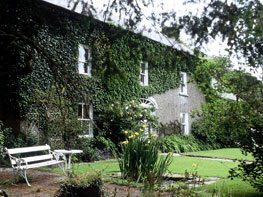











| A few years ago I was visiting my brother and his family in Ballymote "in the County Sligo", a short drive from Ben Bulben, Yeats grave, the West Atlantic. The Shannon flowed gently by at some distance I imagined. The famous Ballymote caves, just behind my brother's house, were high in the cliffs that rose abruptly from what seemed to be the back meadow.
My youngest son, then 12, and I had been admiring the wonderful uninterrupted views around the house in the latter part of a lovely summer's evening. The caves, I explained, hid many Irish in far off and decidedly worse times than we can imagine. Patrick responded in a way that surprised me: he told me that he had always seen himself as Irish. It was one of those moments that should have been respected with a nod or silence. But I was shocked in a wonderful but oddly disappointed way - America has a piece of my heart, for all my Irishness. I blurted, "But you have only been here a very few times. Once when you were a few months old and for maybe a week a few times in the past 12 years. All your favorite things are American. Aren't you an American if most of what you like is American?". Happily for my curiosity and the rapid attenuation of my fraught, ambiguous emotions, he picked up the ball and ran with it. "It's an imagination thing, Dad. I have always felt Irish. Your stories were all from Ireland and nothing can compete with stories." My other children report similar sentiments. Recently, I heard a rendition of "Whiskey in the Jar" erupting (about the only way to describe it) from the bedroom of John, my middle son. It was, God forgive me, Metallica. Worse, I enjoyed it. I said in the silence between tracks, " You know that was one of my favorite Thin Lizzy songs." He goes, "You know Thin Lizzy?". And I go, "Know them? Sure didn't we eat from the same trough??". And he goes, "That is so cool". And I go, "And do you want to know something that is also totally cool?", and he goes, "What?" And I said, (because I would have shot myself had I said "goes" one more time) "My Dad was born in 1915 and it was one of his favorite songs, too." All of Ireland and the US and their cultures, modern and premodern, were bridged across 90 years in that moment. For both of us. We were American-Irish, Irish-American, American and Irish in that momentary burst of shared "Down All the Days" experience. Samara, my daughter, and first child, was in "two's" school. It was a nice Episcopalian pre-kindergarten with gentle creatures in the form of teachers quietly guiding their charges through an activity filled day of self-esteem building. That's what happens when there are no vocations. Anyway, Samara's Mom, Mary, was called to "visit with" teacher. Teacher, ever so gently, said "Well, Mrs. Cahill, we are concerned about Samara's apparent ethnocentricity". "Ethnocentricity", I blew on hearing it that evening. "What in name of all that is good and holy does that mean? She is a 3 year old! Well, that is it with moi and the Episcopalian education system I will bloody well tell you!". "No. No.", my American wife said softly - the teacher's Essence of Gentleness perfume had apparently rubbed off while she was visiting the school - "whenever Samara is asked to tell a story at school she always tells Irish stories. It seems odd to the teacher. That is understandable." Understandable and wonderful. That's my little Irish girl. Episcopalians may now relax. Ye need the bit of Irish, and we are magnanimous about that, so I will let it go with ye this time. Daniel Patrick Moynihan was surely right when he said that it was the Irish who made it American to be ethnic. "Well 'e would, wouldn't 'e.", as the whore in an English court said about a leading politician denying a dalliance. Over the years I have often wondered why my three kids seem to favor one particular part of their respective identities over another. It is in part a function of their parents' personalities. Which parent is the more talkative for example. Great advantage being Irish there. Distance, to the parent's homeland, lends additional enchantment to the growing mind. Children living in one country will, very early on, identify strongly with the parent suffering the loss of his or her homeland. That sense of loss cannot be hidden. And children empathize powerfully with that parent, especially if there are other attractions - like stories set in great castles and Keeps, with frogs, bogs, and fogs providing backdrop. Interestingly, Ireland's natural beauty readily maps to the way a child's imagination fills in a story's scenery. When visiting Ireland my children have said they have this sense of "I have been in this very place before" knowing full well that they may have been to Ireland only rarely and at that "very place" possibly never. If America is the home country, the children are steeped in accepting and valuing other nationalities and cultures. It is a source of no small amount of pride when American-Irish children discover in school that "their" Irish culture is rich in everything from fairies, leprechauns sheegwees and banshees in children's literature, to Synge, Yeats, Beckett, Wilde and Shaw's Irish Literature. Out in the high-tech world of work they see that the Celtic Tiger is also properly part of their inheritance, part of their sense of self. It is all a huge sense of validation. Our Third Culture Kids (or as they are termed in international education circles - TCK's) surely have the best of both worlds. But one has this sense of unease. Unfairness even. Injustice almost. America, is the country of their birth and upbringing. It is their native land after all. Why, with all its cultural riches is America forgotten in this identity selection process? The truth is it is not. My children are American and will likely remain here all of their lives or change the world wherever they go in an American way. They will live, marry, vote, have kids and die as Americans. The majority of their identity is American in day-to-day reality. The Irish part is kept in a special place and it is their American experience that allows that mental duality to prevail without any sense of betrayal to their native land. Their Irishness is profoundly enhanced by their American experience. They will be great Americans wherever they go and great Irish with it. And something else. My children or their children, maybe, will one day visit Ireland. Look after them. Those feelings for Ireland run surprisingly deep in the American soul and remain remarkably fresh through generations. Over here I have noted more times than I can count how ordinary Joe Schmo's look stunned on first hearing my still strong brogue. "That is just how my Grandfather sounded" he will exclaim. "I sure loved him. Man, was he tough - and could he tell stories! Is it Ireland that makes them that way? And you sound just like him! I want to get there one day. It seems like it's so far away and probably expensive to get there. But Ireland is with me all the time. Never leaves me. Now isn't that something." Tread softly with your American guests dear Irish reader, for you tread close to some of your visitors' most profound sensibilities. They are one of your own. More surely than blood sometimes. @ 2003 Tom Cahill |